Tales of Tomorrow – Verdict from Space (08/03/51)

totverdict01Now that I’ve finished Thriller, or at least the “Fan Favorites,” it’s time to get back to the regularly scheduled Outer Limits.  But no, Hulu still has them behind the paywall; commercials aren’t enough. Oh, I know they have a commercial-free option now (yet another cash-grab), but I was ready to swallow my pride.

However, when I went to sign up, I was stopped dead. They are just a little too cozy with the fascist Facebook.  It wasn’t clear on the registration screen that you were not also signing up for Facebook as you enrolled in Hulu.  So fuck [1] Hulu.

And come on, America — why isn’t there a USA release of Outer Limits?  There are Canadian releases on Amazon, but they are absurdly expensive.  I ponied up for season 2 just because of Trial by Fire.  I would probably even spring for season 3 which cost more for fewer episodes, but I have read that they are censored.  Big Brotherish shielding of the delicate eyes of consenting adults from a little bit of constitutionally-protected skin like they are children?  Hey, that’s our thing, Canada!  You speak French, for God’s sake!

So now the coveted slot goes to Tales of Tomorrow.  Yeah, I never heard of it either, but I’m not really in the mood to start Amazing Stories yet.  Tales of Tomorrow ran only 2 seasons (1951 – 1953), but managed to rack up an astounding 86 episodes.  Of course this was an era when actors actually worked instead of spending their time worshiping the president, mocking the country that made them rich, insulting their fans, and trying to ban guns while flanked by their armed bodyguards.

Now on to Verdict from Spaaaaaace!

totverdict02Oh, ach du lieber, we start out with a commercial — I’m getting Hulu flashbacks.  At least these are the original 60 year old commercials, so they might be interesting. Tonight’s episode is brought to you by Jacques Kreisler Watchbands.  Note to research Dept:  I wonder if Apple lets you replace a watchband or do you have to buy another useless Apple watch?

Now on to Verdict from Spaaaaaace!

Gordon Kent has a problem.  Actually, he has two problems: He is on trial for murder and he has an enormous head.  Seriously, he’s built like Steve Rogers before he became Captain America.  So he might go to prison, but on the plus side, his trim little body will make him very popular.  That’s good in prison, right?

totverdict09He is being grilled on the witness stand about $5,000 that was stolen from the corpse of a Professor Sykes and a $5,000 deposit coincidentally then made into his own account. Also by coincidence that is just the sum he needed to start production on a new type of blowtorch he has invented which does not blow and has no torch.

As the jury goes out to deliberate, he sees that his lawyer has been playing tic-tac-toe. Who was he playing with?  There were just the two of them at the table.  No one expects a lawyer to give a damn about justice, but Kent is facing the death penalty, and back when it actually meant something (namely, death) — so I can’t imagine he was in a gaming mood with his rather bulbous head on the chopping block.  He takes this time to reflect on how he got here.

totverdict21While tinkering in his mother’s basement (blogging having not yet been invented), Kent receives an unexpected visit from Sykes, an archaeologist.  He says he has found “the key to the past” and he needs Kent’s new blowtorch to open a secret door.  In a cave, he has found a remarkable machine that has recorded every storm, earthquake and tidal wave for the past million years.

OK, finding a million-year-old computer is an amazing scientific find.  But couldn’t it have done something a little more interesting?  Maybe predict future storms? That technology still eludes us.  I’m lookin’ at you, Yahoo Weather!

totverdict31Sykes insists they go to the cave that very night.  After entering the cave, Sykes is unable to locate the door and Kent becomes skeptical.  Could it be just coincidence or is it the first recorded case of product placement when both their watches stop and we are treated to a closeup of Sykes’ watch — banded, no doubt by Jacques Kreisler.  A watchband was never this prominent again until Die Hard.

This and the eerie score tell them they are in the right cave.  After an extensive search of about 12 feet — literally, you can see Kent and the door in the same initial shot — Sykes locates the door.  It is large and rectangular like the 2001 monolith. Kent takes his new blowtorch to it, which means a little light bulb illuminates on the end.  It seems to Kent and Sykes to be doing nothing (also the audience).  Amusingly, as Kent turns it towards Sykes to comment, the sound effect for the blowtorch continues on.

totverdict35Then they hear a mechanism inside the door.  Kent declares that the door has “a heat lock — heat alone will open it.”  They might have spaceships and weather machines, but we’re light years ahead of them in security systems.  So he lights the little bulb again, and they are able to enter.  Sykes shows Kent the markings on a wire of historic earthquakes and volcanic eruptions.  The first mark on the wire is the test of the atomic bomb in 1945 (so that previous 999,994 years must have been pretty quiet on earth [2]).

The machine begins beeping and Sykes announces that an event larger than an Atomic Bomb has just occurred somewhere on earth.  It is later revealed that this was the blast of a Hydrogen Bomb (which, in reality, wouldn’t occur until a year after this aired).  In an utterly pointless argument and tussle, the machine is damaged.  The ground begins shaking and Sykes is killed by falling rocks which are about the size of dandruff.

totverdict48

Three Angry Men

The jury returns and has found Sykes guilty.  The judge agrees and asks if Kent would like to make a statement.  He tells the jury that “somewhere in this universe, someone has been watching us for a million years.”  He declares that whoever is out there in space was just waiting until we discovered the H-bomb, and then might be a threat to them . . . despite being untold light years away.  He pounds the table and says he “doesn’t know when they are coming, but when they do maybe you’ll realize . . .”

As his odd post-verdict closing statement goes on longer than John Galt’s, a strange sound enters the courtroom.  He runs to the window, points and screams, “look up there in the sky!  Spaceships, thousands of spaceships!”  The screen goes black and the destruction audibly begins.

totverdict51Recorded on video and with a budget that makes The Twilight Zone look like Avatar — also a very poor transfer, or maybe just kinescopes.  The story is certainly hacky by today’s standards and maybe it was even in 1951.  But it was the kind of simple, cornball sci-fi story that I love, so my verdict is a 7.

Post-Post:

  • [1] Only the 4th time I’ve used that word on this blog; I’m trying to save it for special occasions.
  • [2] Kind of a “holy crap” moment to realize this episode aired only 6 years after we A-bombed Japan (give or take 3 days!).  Actually Pompeii and the San Francisco earthquake are mentioned; I don’t know why the A-Bomb was first.
  • So the machine really served the same purpose as the 2001 monolith.
  • The ads for the watchbands state “Fed. Tax Included.”  Hunh?  Was there once a national watchband tax that I forgot about?  If so, that would partially explain why no one wears watches anymore.  Way to kill an industry, government!
  • These bands were running $50 – $100 in 2015 dollars.
  • Written by Theodore Sturgeon, who came up with a couple of classic Star Treks as well as Killdozer.
  • Available on YouTube as is as Killdozer.
  • Hulu sucks.

Ray Bradbury Theater – Downwind from Gettysburg (10/17/92)

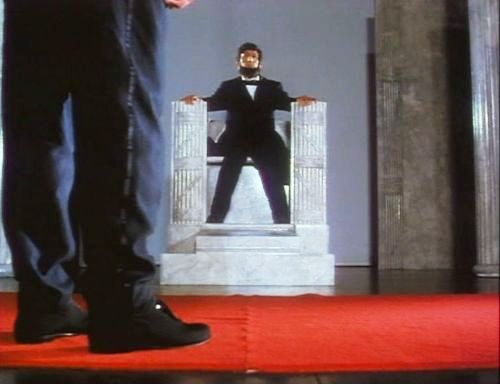
bradbury02We open with a small crew assembling the face and hair to a robot that is revealed to be a likeness of Abraham Lincoln.  This is quite an astounding feat of technology — no wait, it isn’t.  Disney had debuted their anamatronic Lincoln 30 years earlier at the 1964 World’s Fair.

The short story was first published in Playboy in 1969, so this was old technology even by that time.  Frankly, Playboy  would have been better advised devoting their robot stories to someone like Anita from Humans or Ava from Ex Machina.  Or Valerie 23.

Sitting in a huge chair similar to the uncomfortable one in the Lincoln Memorial, Lincoln begins reciting the Gettysburg address.  Disney’s earlier model could even stand up, but this marvel of technology just sits there like an animatronic FDR.  Apparently this is to be a huge media rbtdownwind06event in an auditorium, and covered live by the network; or at least the Weekly Shopper.

Chief Engineer Bayes has wisely embargoed any view of Abe.  In reality, this ought to be about as ground-breaking as someone unveiling the creation of  Windows 95 today.

Bayes tells his assistant Phipps that his great-grandfather was actually on the battlefield to hear the speech.  Phipps says, “He must have been a young boy.”  Bayes confirms that the boy was 9 years old.  OK, Bayes is 52, and the speech was given 129 years ago.  That means the average age at which the women in this family gave birth was about 28.  I was hoping for some embarrassing mathematical anomaly.  I guess 28 is slightly high for the times, but not crazy.  But I digress.

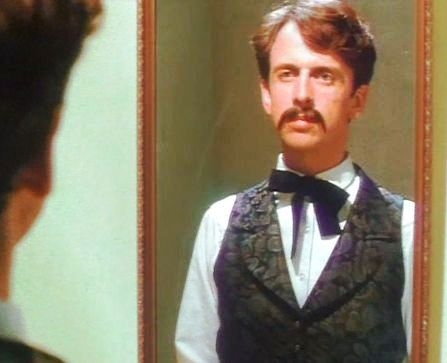
rbtdownwind16While the crowd is being seated for this extravaganza, a man rushes in the entrance, asks where the restroom is and heads straight for the head.  He changes into 19th century clothing and affixes a fake mustache, wisely, beneath his nose.

As the lights come up, Robo-Lincoln begins reciting the Gettysburg Address.  In the wings, the mustached man loads a Derringer.  In a repeat of history — as any public school graduate can tell you — Lincoln is once again assassinated during the Gettysburg Address.  He must have had a critical circuit hit as he slumps over and his words whir to a stop.

This time the assassin does not make a dramatic getaway.  Phipps and the security team hustle him back into the empty auditorium as Lincoln lies slumped to the side of his chair, oil dripping from his mouth.  The shooter says his name is Norman Llewellyn Booth, rbtdownwind13although the invitation does not say Booth.  Phipps brings in Booth’s forged invitation, saying that is how he got in.  Well, no, actually he got in be claiming he needed to go to the bathroom, but that wouldn’t look good in the history books.

Why did he do it?  We are given several options:  1) Booth wants the fame that will come from being arrested, 2) the permanence and perfection of machines which he can never achieve infuriates him, and 3) Booth / Lincoln . . . it was just destiny, too good to pass up.  He envisions the news scrolling across Times Square: “Booth Shoots Lincoln . . . again!”  or 20 years later, being posted to Salon.com:  “Tea Partier shoots Robot-American.”

When the police arrive, Bayes refuses to allow Booth the notoriety he craves — he will not press charges.  He tells Booth, “This assassination never happened.  You can tell your rbtdownwind23story, but we will deny it — you were never here.  No shot, no gun, no computer data processor assassination, no mob.”  Well, except for the shot, the gun and the assassination witnessed by the mob in the audience.

Bayes is quite happy at denying Booth his fame and infamy.  He grabs Booth by his snazzy vest and tells him that he ever dares tell anyone what occurred that night (presumably other than the audience, crew, security team and coupon clippers), he will do something to Booth “so terrible that he will wish he had never been born.”  Bayes throws him out a side exit where no one is waiting for him.

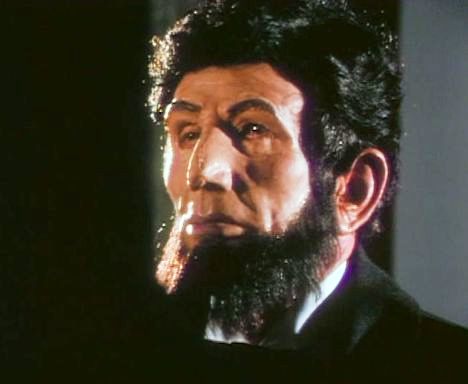
The anachronism of the robot sinks the entire production.  No one would care about this event — the robot or the shooting.  Also, the make-up is abysmal, sometimes looking like leftover scraps from Planet of the Apes. The beard — completely wrong.

rbtdownwind25Sadly some good points are lost among the carnage.  Howard Hesseman (Bayes) and Robert Joy (Booth) are both excellent.  This is probably one of the earliest shows to show fame-seeking as a motive.  The idea of throwing him out to an empty street is great, but the speech leading up to it was horribly cliched.

If Bayes wanted to make an effective threat, he should have threatened to break his leg, just as John Wilkes Booth had done.

Rating:  Stay upwind from Downwind from Gettysburg.

Post-Post:

  • Robert Joy (Booth) played another feckless assassin in the excellent but largely forgotten historical movie Ragtime.  Harry Thaw was famous only for shooting Stanford White.  White was famous for being shot by Harry Thaw.  OK, both had other accomplishments, but nobody cares now, and that’s not going to change as more time passes.
  • Sady, no references to Hot Rod Lincoln.

Alfred Hitchcock Presents – Disappearing Trick (04/06/58)

ahpdisappearingact08Usually an oasis among some of the other shows and movies, this outing has dull performances (but by beautiful people) and a fairly dull story.  It is a sad commentary to say that this episode is barely worthy to share the week with the last few 20-for-$7.50 movies.

Bookie Walter Richmond — one of them suave, handsome, stylish  suit-wearing, coiffed, tennis-playing bookies you always hear about — strolls into the office just in time to get a call.  His weekend plans in La Jolla are ruined by his boss who wants him to check on an old client who has suddenly stopped making bets.  Also by his inability to find “Lahoya” on the map.  He gets some expense money and sets out to find this mysterious Herbert Gild.

ahpdisappearingact10In La Jolla, Richmond drops by the fabulous casa de Gild and rings the bell.  The girl answering the door — his wife Laura — kind of rings my bell.  She is an exotic blonde who looks like she was all dolled up in a cat-woman suit waiting for someone to drop by.  She invites Richmond in and tells him her much-older husband has been dead for six months — if only there were some sort of notice in the newspapers about that sort of thing.

Back in the office, Richmond learns that Gild last placed a bet 3 months ago; 3 months after his supposed death.  He finally does think of checking the newspapers, and the obit is there just as Laura said.  Body count:  Herbert’s was mysteriously never found, and Laura’s is simply unbelievable.

ahpdisappearingact28Richmond makes another unannounced call on Laura.  He tells her his theory that she was cheating on him with younger men, and he just wanted to get away from her. She admits to the cheating, but plays dumb about the faking of his death.

Richmond tracks Herbert Gild down in Tijuana and poses as an insurance investigator.  Had he posed as an insurance salesman, maybe Gild would have been more evasive.  Gild offers him $10,000 to say he was not found, and Richmond takes it.  When they get back to Laura’s apartment, Gild is there.  After the slightest of struggles, Gild shoots Richmond in the shoulder.

He gets a doctor to work on it.  He says the shoulder will heal, but will always be stiff.  “Not too bad unless you’re a tennis player.”  Oh, and Laura fled with the $10,000 of cash that he stupidly left in his jacket pocket in the waiting room.  Richmond laughs, as you do when you lose a hot babe, are robbed of $10,000, your favorite hobby is ruined, and your hook for picking up chicks is compromised.

“I can’t understand why the customers aren’t beating down my door.”

Post-Post:

  • AHP Deathwatch:  Robert Horton is still hanging on, and Betsy Von Furstenberg just died this year.
  • You can always trust a business card with no address or phone number.
  • Laura was 27 years younger than Gild.  Which is starting to make more sense to me.

Night Gallery – Hatred Unto Death (05/27/73)

hatredunto01Primatologists Grant and Ruth Wilson are driving through stock footage of Africa.

They are stopped by 3 natives in the road.  Grant understands enough of their language to follow them to a pit where a gorilla has fallen.  Looking up at them, the gorilla is pas-sive toward Ruth, but when he looks at Grant, he is full of hate.  Grant, not a wordsmith despite writing a book, says, “Look at that hate — it’s almost as if he knew me.”  That could be taken 2 ways, Shakespeare.

Ghatredunto04rant has the natives throw a net over the gorilla so he can take him back to America to go to a zoo. Ruth tries to convince Grant to let him go free; or at least take him to the movies instead.

Over a picture of the gorilla, we see a transparent overlay of his journey from the natural wilds of Africa to the smokestacks and freeways of evil America.  The Wilsons temporarily house him at the Museum of Natural History run by their associate Fernando Lamas (best known for not being Ricardo Montalban).

When they take Lamas to see the gorilla, it once again is subdued toward Ruth, but very belligerent toward Grant.  Grant mocks Ruth for holding the gorilla’s hand while they flew to America to keep him from going into shock.  He jokes to Ramirez that he thinks she prefers gorillas to men.  She says, not joking, “Gorillas don’t drop napalm on children.”

hatredunto10She continues, “This earth doesn’t really need man.  He’s only ruining it. The gorillas and the elephants and the porpoises would manage and work things out very well by themselves [1].  Without men, this would be a fabulous place!” Colleges all over the country would be fighting to hire this woman for every primatology, history, womyn’s studies and diversity department today.

She opts to stay the night keeping the gorilla company rather than go home with her husband.  Grant confides to Lamas that he should have left the gorilla in Africa.  But when he looked into its eyes and saw the hatred, he knew the gorilla recognized him; perhaps as Hondo Harrelson on SWAT. He wants Lamas to break the gorilla’s spirit, turn him into a vegetable.

hatredunto22Meanwhile Ruth is telling the gorilla stories about how ancestors of Grant and the gorilla fought many years ago.  Strangely, they fought over a female.  A female what is not mentioned.  Being different species, that would be interesting.  Where she is getting this scholarship is anyone’s guess, but anyone at a college knows such questions will get you fired.  The ancient man, being an ancient man had the brains to trap the gorilla in a pit, take his female, and stone him to death. Now the man smokes a pipe, wears a leather coat and bangs a hot blonde; while the gorilla’s descendant is still getting trapped in pits.

Ruth’s interpretation to the gorilla is that “down through the eons [man] has grown pale, and weak and hairless.  Still he’s your master!  What’s happened to your power?”  She is heartbroken that man has evolved to a superior state.  I swear, if the gorillas had anti-aircraft guns, she would have been yukking it up with them.  This agitates the gorilla so he grabs her earrings from her hand.  When she enters the cage to retrieve them, he makes a jailbreak, knocking her to the ground.  She manages to call the pale, weak Grant to come save her.

Luckily the weak man has invented the gun and flashlight.  And I’m sure Ruth would have called for the napalm now that the gorilla had begun attacking her.  After some cat and mouse through the museum, the gorilla — shot twice — tricks Grant by playing dead, then picks him up and impales him on a statue before dying.

The episode ends with a pan from Grant’s dead hand, to the dead gorilla to Grant’s pistol, to a bust of a caveman; which I’m sure conveys some meaning that is so stupid you have to go to grad school to get it.

Post-Post:

  • Twilight Zone Legacy:  Richard Deacon and Steve Forrest did time in the Zone.
  • [1] Apparently the cobras, lions, sharks and scorpions would not get seats at the table.
  • Skipped Segment;  How to Cure the Common Vampire.  A very short sketch which makes no logical sense as a joke or horror.

Tales from the Crypt – Death of Some Salesmen (10/02/93)

tftcdeathofsome02After we see Ed Begley Jr. humping some floozy in a hotel, he is up early the next morning to check the newspaper obituaries; presumably to see if my appetite is listed. Actually, we were fortunate enough to see very little of him, but did get some swell nudity from the girl — in a show hosted by a puppet. That still baffles me.[1]

Apparently he made her promises about rescuing her from her lousy job and that dirtwater burg.  She accuses, “But you said you loved me” and he responds, “Yes, and you dropped your little panties.  It’s called salesmanship.”  No, it’s called lying.  Sharknado / Sharknoddo.

He drives out to a farm where Yvonne DeCarlo answers the door.  Asking for her husband, she tells him her husband died a few days ago.  Unlike her first husband, this one ain’t coming back — not even on TFTC.

tftcdeathofsome07He pretends to be shocked and does a variation of a gag that Chevy Chase did so much better in Fletch. He explains that just last week her husband had made a down-payment on a cemetery plot. He says it is too bad he died before paying the balance because the plot package covered funeral expenses plus $10,000 cash.  “Reluctantly” Ed agrees to bend the rules so Yvonne doesn’t lose out on the bennies (i.e. he bilks her out of $250 cash).

Having ungilded the Lilly (see what I did there?), he arrives at another farmhouse.  In a bizarre but fairly pointless bit of casting [2], the door is answered by the always welcome Tim Curry, but playing a woman (an actual woman — Ma Brackett — not just a sweet transvestite).  Although he went to the wrong address, and there was no obituary to lay the groundwork, Ma is still interested in what he is selling and calls out Pa Brackett — also played by Tim Curry. Very strangely, Ma looks like Tim Curry, but I can detect no resemblance in Pa.

tftcdeathofsome10They are very impressed by the brochures he has had printed up. He generously offers them a package deal for $750 that will provide $20,000 in death benefits.  Sounds like a good deal to them, but Pa is pretty shrewd and says they will have to see the plot in person.  Ed is able to stall them for a day and they go down stairs to get the cash.

While alone, Ed sees several of his predecessors — salesmen who have been decapitated, gutted with vacuum cleaner hoses, stuffed into TV consoles, etc.  He heads for the door, but is locked in and Pa clubs him to unconsciousness.

They rouse him, handcuffed,  and introduce him to their daughter Winona (also played by Tim Curry).  Despite all manner of hideousness, he tells her she is beautiful.  She takes him upstairs and rides him cowgirl style, although more cow than girl.  During pillow talk, she says she wants to get married so they can take her dowry and get away from her parents.  The dowry is money from all the dead salesmen and Winona estimates it at $40 – $50,000.

tftcdeathofsome08Begley shoots Winona and digs down about 4 feet in the basement where he finds a box with a piece of paper in it.  He unrolls the document to see one of his own contracts for a Restful Hill Cemetery plot — that is the dowry. This is where things go awry.

The contract is a mess.  I guess they figured that no one would notice in state of the art 1993 low-rez TV. Why were Mr. Jones and Begley filled in the Witness line rather than as the active parties?

And why was it buried under 4 feet of dirt?  Did one of the family dig the hole that night? And then fill it in?  For what purpose?  OK, the microwave salesman’s head was in the microwave, the TV salesman’s body was stuffed in the console, so it makes sense that Begley would be buried.  But irony shouldn’t require that much work.  In fact, irony should require no work  — the universe does the heavy lifting.

tftcdeathofsome06Turns out Begley was shooting blanks (with the pistol, presumably not in bed).  Winona is not dead, and Pa blows Begley away just before telling him that this is salesmanship — a phrase that sort of worked in the beginning, but makes little sense at the end.

If you overlook the nonsense at the end, it is a fun episode with great performances from Begley and especially Curry.  It was nice to see Lilly Munster again even though she had put on a lot of pounds and years (but haven’t we all).

Post-Post:

  • [1] It never occurred to me before that there really aren’t any cute Muppets. Granted, there aren’t that many humans among them, but — again, just occurring to me — they are almost all male. In fact, the only female I can think of is Janice — a groovy chick, but with a mouth that goes half-way around her head.  Just because it works — awesomely, BTW — for Anne Hathaway, doesn’t mean everybody can pull it off.
  • [2] Maybe I was wrong about the pointless casting.  The IMDb also cites his Emmy nomination for playing mother/father/sister/daughter, but he only portrayed 3 characters.  Sister and daughter don’t count as two people — this ain’t Chinatown, Jake.  Maybe this is why they all look so similar and the daughter is a little off.
  • The ugly daughter is named Winona.  Begley’s name is Judd.  Coincidence?  Just as an aside, PC I am not, but I never call real people ugly.
  • Title Analysis:  Inevitable, I suppose.  But shouldn’t it be “Deaths” since there were several killed?  Maybe “Death of Another Salesman” would have been a better choice grammatically and parody-wise.