When Super Apes Plot – Anthony Wilder

pulpfiction01We open in a seaplane that has set down in a lake in Borneo.  Similar to Servant of the Beast, there is an elderly professor, his hot niece, and a black guide, Batu.  In this story, the 4th wheel is the girl’s husband — so I’m confident there will be no love triangle, this being 1919.

They have brought presents to pacify the Bamangani natives which should “keep them jabbering with delight for years.”  Er, at this point, it seems that the titular Ape-Men are the natives.  Awkward.

Dr. Dumont has come to Borneo to study the natives — he wants to see if any of them have . . . uh, tails.  He does at least concede that they “used to be” headhunters and cannibals — so that’s progress.  The young couple, Tom & Irene, are given no motivation other than “Borneo brought back memories of the days when they first met.”

After breakfast, Tom & Batu arm up and take a boat to the shore.  As they explore the jungle, Batu spots the footprints of many feet and determines that they are moving toward the plane.  They hear two shots ring out — the universal distress call of hot babes being attacked by natives.  Although two shots in the noggins of their attackers might have been more effective.  Making their way back to the plane, they see Dumont and Irene being perp-walked through the jungle.

Tom & Batu confront the group.  Batu, speaking their language demands that his friends be released.   The natives are taking them back for trial in the death of a man shot while boarding the plane.  Surely this would be a kangaroo court — literally — so Tom & Batu let their “talking-sticks” speak for them and the four explorers make their escape.

After Dumont is hit by a spear, they hole up in a cave for a while.  Under cover of darkness, they make their way back to the plane.  Having learned nothing, Mike & Batu swim out to the plane, leaving Irene and her injured uncle behind.  Naturally, they are again abducted.  Tom dives into the water and storms the beach but is taken down by 10 of the tribe.

The three of them are taken to a hut near the volcano which has been rumbling.  So I’m thinking sacrifice.

Fortunately, Batu saves the day.

Meh, pretty standard stuff.

Post-Post:

  • First published in Top-Notch Magazine, December 1919.
  • Also that month:  Not much of interest . . . dullest month ever.
  • WTH?  This story features the Bamangani; Tarzan fought the fictional Bolmangani, also a race of “gorilla men.”.

Alfred Hitchcock Presents – The Perfect Crime (S3E3)

ahpperfectcrime02Before watching:  Woohoo!  With a title like that, you know Sir Alfred is going to take the directorial reins for this episode!

After watching:  Master of suspense? Yeah, the suspense was when is something going to happen?

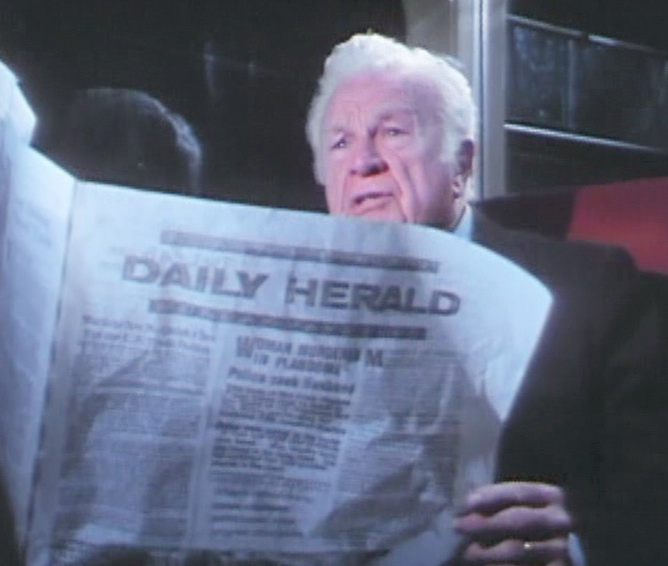
Charles Courtney (Vincent Price) is adding another exhibit to his collection commemorating crimes he has solved.  Back in the old days, this was called evidence and kept by the police or returned to the victim.

He receives a late night visit from defense attorney John Gregory (James Gregory — really, they couldn’t have at least changed the character’s name to Greg Johnson?).  Price notes that he has seen Gregory in the courtroom four times.  All four times, it sounds like Gregory’s clients were found guilty and executed; bizarrely, nothing is really made of that.

Gregory notices a blank spot in Price’s trophy case.  He explains that it is reserved for the titular perfect crime, a real work of art.  Rather than being vacant because the person was — by definition — not caught, it is vacant because Price feels no criminal mastermind has ever risen to his level to deserve the spot.

ahpperfectcrime12The conversation turns to the trial of No-First-Name Harrington for the murder of Ernest West.  Gregory says he might have represented Harrington if he had not been out of the country.  Since Harrington was just executed, it sounds right up his alley.

Price recounts in a flashback how West was found dead by his housekeeper.  He is lead to Harrington by analyzing tweed threads, tire treads, footprints, and financial evidence.

A certain stock had risen 57 points in the days leading to West’s murder.  Two days after his death, the stock dropped 63 points.  Price found that Harrington had been selling short as the stock rose and was on the hook for 132,000 share when West was killed.  At the same time that Harrington was selling short, West had been buying up all he could. So Harrington killed West — it was, as Price describes it, “murder for millions.”

There is nothing in that scenario that makes sense.

Gregory finally discloses that he knew West, Harrington and Harrington’s wife Alice.  And furthermore, Harrington was innocent and Gregory can prove it.  He tells an alternate version of the story that begins with the Harringtons and West being in a love triangle.

ahpperfectcrime03In another flashback, we see Gregory sitting in a fancy Monte Carlo hotel room talking to Alice.  And I literally mean SEE — for some reason, there is no dialog in the flashbacks other than the narration of the two stars. Alice hands Gregory a letter from her husband which is abusive.  They agree that her husband deserved to be killed.

Gregory brings up other facts that contradict Price’s version of events, or fill in certain gaps.  It soon becomes clear, unfortunately in yet another flashback, that Price has been responsible for sending the innocent Harrington to the gas chamber.

Welllll, let’s not go crazy with that innocent-talk.  Harrington was standing right beside Alice when she shot her husband.  Then he covered it up, or at least did not rat her out.  So really, the only miscarriage of justice is that Alice wasn’t sitting in his lap when he got fried.

Rather than spilling the beans, all Gregory wants is for Price to ease off next time when he has a client facing the death penalty.  Because, while it would be fun the bring the smug Price down to earth, and would benefit society to bring the shooter to justice — the important thing for a defense attorney is to be sure we get as many future murderers back on the street as possible.

This isn’t good enough for Price who fears for his reputation if this ever got out.  So that’s it for Gregory — Price commits the perfect crime.  Sadly, the moral police could not let just this one episode go by with a killer getting away with his crime.  Hitch gave his standard closing, assuring the audience that Price got caught.

ahpperfectcrime18The epilogue is a little muddled as we learn that Price stuffed Gregory into his ceramics kiln and made him into a vase.  His hobby of ceramics was quickly mentioned early in the story, so that part is not a complete non-sequitur.  But can the human body be incinerated down to clay?

And it was such a plain vase.  There should have been something to tie it to its source material — like being very fat or thin if that matched the body type of Gregory.  Or a bowl with a lid that resembled a unique hat, or at least color that matched his suit.  Or maybe something like the Hitler Kettle.

Overall, the performers did a great job, but it was just too talky and reliant on narration over the silent flashbacks.

Post-Post:

  • AHP Deathwatch:  Ironically, Harrington is the only survivor.
  • I supposed Gregory’s constant losses to Price were the reason for his extortion.  It just doesn’t really work because Gregory comes across as an confident, intelligent attorney.
  • Price took a 2 year world-tour after killing Gregory.  He says he preferred Angkor Wat to the Taj Mahal.  Fine, but that just seems strange to randomly drop in the script.
  • Alice’s fate is not given in the episode, but she possibly went on to be part of the biggest crime of the last 50 years.

The Dead Book – Howard Hersey

pulpdeadbook01The good news is, it is short — only 134 of whatever arcane units the Kindle uses.

A group of men are stationed in Mindanao in the Philippines.  It is said that if you are stationed there, you should “forget that women ever lived, leave drink alone, and never worry.”

When one of the men, Carson,  commits suicide, Kennedy opines that “a white man was never intended for such a beastly life.”

Carson had become interested in a monastery on the island.  He learned that there was an old hand-painted bible there which had been brought over by Magellan.  The bible was kept behind a closed door, and chained to a desk.  It was said that anyone who spent a night studying it, would never come out alive.

Carson would be the first person to 50 years to examine the book.   When he entered with one of the monks, the monk fell, pulling a table a table over on top of him and crushing his skull.  This sent Carson screaming down the hall.  Carson is nursed back to health from what seems to be no more than a case of the willies.

This is where it gets confusing.  Carson believed a tarantula was behind the deaths.  In his quarters, he believed he saw the tarantula and shot himself.  Let’s examine that.

Kennedy’s theory is that Carson saw a red tie in the mirror and believed it to be the tarantula.  Ted Kennedy’s theory on Chappaquiddick is more believable.  Kennedy refers to “a string” in the book which I am interpreting as one of those ribbons that were used in bibles as a book mark.  That doesn’t look much like a tarantula to me.

Then he believes that Carson pulled out his pistol and pointed it over his shoulder to kill the tarantula, and accidentally shot himself.  Wouldn’t a shoe or the Sunday New York Times have been a more effective weapon (and equally reliable as a source of news)?

This could have been a good story in the vein of The Adventure of the Speckled Band or The Problem of Cell 13.  Instead, it is just a waste of time.

Post-Post:

  • First published in The Thrill Book, July 1919.
  • Also that year:  1st Class Postage drops from 3 cents to 2 cents.  Wait, what?

Night Gallery – The Dear Departed (S2E11)

ngdeardeparted04The episode opens at a seance being conducted by Radha Ramadi aka Mark Bennett aka Steve Lawrence aka Sidney Liebowitz.  Bennett is summoning his spirit guide Running Deer.  He seems to be a little confused — although he is technically wearing authentic Indian garb, it is a Nehru Jacket.

Running Deer makes himself known by playing the traditional Indian instrument, the tambourine.  Bennett tells Running Deer they are trying to reach the spirit of Dorie Harcourt whose mother is at the table.  Dorie appears in the form of a porcelain head that seems to have toilet paper flowing from her shoulders.  She drops a stuffed elephant onto the table which convinces her mother that this truly is her dead daughter’s toilet paper shedding, disembodied, immobile mannequin head.

ngdeardeparted07Dorie’s mother offers Bennett a little something extra for contacting her daughter.  He makes a good show of refusing it, but it does end up in the pocket of that Nehru jacket.  After she leaves, he is joined by his partners Angela and Joe Casey, with whom he will split the $500 windfall.

Joe thinks he is not cut out for this life.  He believes himself to be too coarse and low-class to work with Bennett, too unsophisticated.  Bennett is brilliant in giving credit to Joe for their success at hustling the rubes.  He says Joe is an artist, and tells Angela that she should be nicer to him.  On the other hand, it is revealed that Angela and Bennett are having an affair behind Joe’s hairy back.

At dinner, they try to ditch Joe so they can have the sex, but Joe and Bennett are both just too nice.  Bennett agrees that the three of them will go out to a movie.  Joe runs out to get Angela something for a headache and is run down by a car.

The next day, Bennett is forced to prepare all the special effects that Joe used to handle for the seances.  Without Joe, Running Deer is a less adept at the tribal tambourine than Davy Jones.  When Bennett pretends to summon a woman’s dead husband, we get another lifeless disembodied head.  This time, without Joe’s steady hand, it is bouncing around and the voice is is crazy.

ngdeardeparted24When he tries again to summon the man, Joe appears instead — not as a doll’s head, but as a true translucent ghost.  He says that they are going to “stay a team — forever!”

The ending fails completely because there is no sense of danger attached to Joe’s appearance, even at the threat of forever.  NowDelbert Grady’s daughters really knew how to really work that word.

ngdeardeparted40Steve Lawrence never got his due because he was mostly a lounge singer.  But he was a good actor, and really sells this role.

Post-Post:

  • Twilight Zone Legacy:  None.
  • Skipped Segment:  An Act of Chivalry — another short sketch not worth the words already typed.

Night Gallery – Pickman’s Model (S2E11)

ngpickmansmodel12The episode is framed by scenes with art connoisseurs Larry Rand and Eliot Blackman.  Based on their performances and the superfluousness of their parts, It is reasonable to suspect the producer of casting his relatives once again — they do have other credits, however.

In the opening scene, they are arguing over the authenticity of a Pickman painting.  All but 4 of Pickman’s oil slicks mysteriously disappeared along with the artist 75 years ago.  Rand observes that the signature “looks real enough.”  This analysis doesn’t even rise to the level of tire-kicking when buying a used car.

Because he discovered the painting hidden in his current studio, Blackman believes the studio must have once belonged to Pickman.  Fortunately, rather than filming a title search, the story quickly flashes back to Pickman picking up a few bucks by teaching a drawing class to a group of “young ladies of good families.”

ngpickmansmodel17

A little over the top, but appreciated.

He is showing the same painting — Ghoul Preparing to Die — to his class, telling them that it was the result of “drawing what he sees” and that it caused his expulsion from the Boston Art Institute, removal of two of his canvasses from the Cabot Museum, and a punch in the nose.

One of the ladies — Mavis Goldsmith — seems to have a similarly morbid style, seeing a vase of flowers and drawing them as dead and wilted.  Pickman is intrigued by her drawing, but can’t resist drawing the beast’s face in the corner like a Mephistophelean Kilroy.

Mavis tracks Pickman down in a pub.  She asks to go to his studio, but he refuses; no one even knows where it is.  Fortuitously, the location is given away in a Pickman painting that she recently purchased.  Both Pickman and Mavis’ uncle tell her of inhuman tunneling beasts that practice unspeakable acts in the area of his studio.

ngpickmansmodel33Mavis goes to Pickman’s studio against his wishes, and lets herself in.  She wanders into his studio where she sees several paintings all depicting grotesque scenes, many with the same beast.  Pickman discovers her and is in the process of throwing her out when there are noises heard in the hallway.

Pickman grabs a fireplace poker and runs out.  The beast enters and begins carrying Mavis out, when Pickman attacks.  There is a clue as to why Pickman always wears gloves as we glimpse that his bare hand is partially covered with scales — a product of the beast “pro-creating” with his mother.  It is a very quick shot, and I suspect they realized this, so inserted the exact same piece of film a few seconds later so we get a second look.

The beast prevails and carries Pickman’s body down to the tunnels.  Mavis calls her uncle to come loot the gallery.  Her uncle says he must have been insane.  Mavis says, “No, he just painted what he saw . . . and was.”

ngpickmansmodel44We return to the present day. Searching for additional paintings, the two men find a mysterious brick enclosure in the cellar. They start pounding away at it, hoping to strike it rich.  The paintings are not entombed there, but something is.

The episode is so fleshed out that only the bare essentials of Lovecraft’s story remain; and one critical point is abandoned completely.

There is no Mavis in the story — her addition was necessary and welcome.  In the story, the entire narrative is told by one of the dealers in the opening scene — that would have been deadly, especially with these particular actors.  The two men are named Thurber and Eliot in the story (presumably after the writers) — Thurber’s name is changed for the episode.  In the story, the main painting is called Ghoul Feeding, which is much more menacing than the episode’s defeatist title, Ghoul Preparing to Die.

The “Soylent Green is people” moment from the story involved Pickman taking photos and painting his backgrounds from them rather than painting them “live.”  The final revelation that the beast was the subject of one photograph could have worked on TV, but I didn’t miss it.

Overall, great production and great performances from Bradford Dillman (Pickman) and Louise Sorel (Mavis).  Good job on the adaptation, also.

Post-Post:

  • Twilight Zone Legacy:  None.
  • Lovecraft’s story was first published in Weird Tales, October 1927.
  • Despite not being anything extraordinary, the Lovecraft story seems to be a favorite of many people.  There have also been a number of productions of it, some switching the genders of the lead characters.  And one CGI version that is like The Sims: Lovecraft.
  • The only Cabot Museum in Boston is a fictitious one used by Lovecraft in other stories.  Just a little harmless fan-service, I guess.