Carl and Annette Borden are at a going-away party for career girl Lorna. She is moving to San Francisco and leaving her enormous dog Cassandra with the Bordens.
The Bordens have their friend Perry over for dinner. Carl has stomach pains which Annette oddly attributes to strawberry shortcake. In the kitchen, Carl doubles over and calls an ambulance. His doctor agrees that it could have been the strawberries in combination with some other rich foods. Not since The Caine Mutiny have strawberries been involved in such nefarious events.
The next day, Annette finds Carl passed out on the floor of her studio. The doctor later determines that he ingested arsenic. Although, it could have been that big-ass bong Annette is making. Both times he has taken ill, Annette prepared the meals.
He throws the doctor out at his implication of Annette. He looks through the studio and notices some of the paint is made with arsenic. When Annette offers him some juice, he reluctantly drinks it.
My God! Look at the size of that bong!
They decide to take a vacation. While Carl is packing the car, Annette drinks from the wrong coffee mug, and Carl finds her dead on the floor. Having established himself as the victim, it is easy for everyone to believe that Annette accidentally poisoned herself.
Quick cut to Carl in a car with Lauren and Cassandra explaining how he pulled it off.
The episode doesn’t play completely fair, but it gets the job done.
Post-Post:
AHP Deathwatch: No survivors.
Phyllis Thaxter played Ma Kent in Superman. The good one.
Not sure what’s going on with that title. It kinda seems like Latin for “evil in the home,” an approximation of Hitchcock’s description of his series. But it also sounds like a breed of dog. Or cat.
John Meredyth Lucas wrote the Star Trek episode where they went to the Nazi planet. That episode starred Skip Homeier from Momentum.
aka The one Steven Spielberg directed. No doubt Rod Serling was the draw for this movie when it aired, and maybe there were some lingering Joan Crawford fans. But a few years later, Steven Spielberg is the main reason anyone would remember this episode, and he maybe serves as a gateway for the entire series.
Joan Crawford is “a blind queen who reigns in a carpeted penthouse on 5th Avenue. An imperious, predatory dowager.” She has summoned her personal doctor to her apartment building where she is the only resident. It is not clear whether this is by design or just no other tenants would be willing to live this close to her.
She has read about heard of a new procedure that could possibly restore her sight. It has only been attempted on a chimp and a dog, and restored their sight for just a few hours. The doctor says it is still experimental, but Joan is convinced it will work on a human. And, by the way, she would need a donor willing to give up their sight for the rest of their life to provide her a few hours of sight.
Her lawyer has found a man who would donate his eyes for the grand sum of $9,000. The doctor is repulsed by the thought, but Joan blackmails him into performing the surgery.
We cut to Tom Bosley channeling Lou Costello. He is in a playground explaining to the world’s least intimidating loan-shark why he doesn’t have his cash. The knuckle-breaker has him on a kid’s Lazy Susan spinning him around; if he doesn’t come up with the dough, it could result in a Dutch Rub.
Bosley tells him that he has $9,000 coming to him which will exactly clear his debt. Bosley later makes it clear that he will commit suicide after the operation. So he is a real sport to take care of his gambling debt first. Some pricks might have stiffed the bookie and left the cash to a children’s hospital.
Apparently hospitals back then were just like today — hours after having experimental surgery on her eyes, Crawford is discharged and sent home.
She begins unwrapping the bandages and when her eyes are exposed, she is able to see for the first time in her life. This being a Rod Serling joint, that can’t be allowed to stand. In a twist very reminiscent of TZ’s Time Enough at Last, there is a blackout of the city which again plunges her into darkness. NYC had just had a massive blackout four years earlier, so this was not a crazy concept to the audience.
It is possible to be churlish and point out the flaws in what follows. So I will. OK, there is a blackout, but how did it become bottom-of-a-coal-mine-pitch-black? Her apartment has windows. She even stumbles down the stairs and outside, but is stopped by a fence. Panning up a few feet over the fence, a street scene shows plenty of light from the moon and car headlights.
Distraught, she is furious at the doctor as she believes he botched the operation. She makes her way back up to her apartment. She wakes up in the morning, and is able to see the sun rising over the New York skyline. She is enthralled by its beauty, but it is short-lived as her sight begins to fade. Her sight lasted 11 hours and it was stolen by the blackout and squandered on sleep.
In several ways, it is easy to believe this is the work of a 21 year old first-time director — but I mean that in the best possible way. There are shots and camera tricks here that a veteran — including the older Spielberg — might have avoided: Jump cuts, shooting a reflection through a bead on the chandelier, a spinning chair fading into the Lazy Susan, the stark color of Joan Crawford in a red dress stumbling around a totally black background to indicate her blindness, focusing on innocuous items such as a manila envelope or light switch.
My favorite is the scene above where Spielberg allows it to play out with the blind Joan Crawford addressing the doctor at the spot where he had stood earlier, not realizing he has moved. Would Grampa Spielberg have left that in? I’m not sure. I am baffled why artists tend to smooth everything out as they age. Writers seem to think a plot cheapens a novel, composers plod along and never establish a tune, and directors avoid the flair that makes movies fun.
I rate it a 20/20.
Post-Post:
Maybe Joan Crawford considered this slumming after her stellar movie career. But she could have gone out on a high note had she not made one last movie after this one.
She has great blue eyes and spent 99% of her career in B&W movies. No wonder she was so pissed all the time.
Crawford plays Claudia Menlo; Thomas Edison was known as “The Wizard of Menlo Park.”
After watching the archaic, completely artless Teenage Zombies, the opening to Tales from the Crypt — simple as it is — is nothing short of electrifying. And, by “opening”, I mean skipping the odious Crypt-Keeper and diving right into the story.
Sure, it has the advantage of color, but it also uses music and just a few establishing shots to set the tone. A big-ass Cadillac driven by a dude in a big-ass cowboy hat, boots hitting the ground, a spin of the roulette wheel, the wheels on a slot machine. None of these are budget-busters or require editing genius, but put the right music — even carefully chosen stock music — underneath them, and it makes the difference between film-making and pointing a camera.
It also helps when the cowboy, Reno Crevice, is played by Lance Henricksen, but then the budget starts taking a hit; although from some of the crap I’ve seen him in, maybe not a big one. He has a drink in the casino, and is warned that Sam Forney (Kevin Tighe) is a guy to look out for. They have tangled before, so Crevice goes directly to challenge him.
Crevice is a little short on funds, so the stakes for the wager are loser must leave town. Crevice rolls a 12, but Forney matches him.
Increasingly agitated, Crevice suggests Russian Roulette. Forney provides a revolver and Crevice loads a single bullet, pronouncing it to be “5 to 1 odds.” They take turns clicking off shots until the final chamber, which misfires.
Determined to see this through, they next try cards, using their fingers as the stakes.
Henricksen and Tighe are both excellent, playing up the campy roles while retaining the danger. The episode is also very well directed by Walter Hill. And the ending . . . er, it’s very well done. It’s the kind of thing you’ll like if you like that kind of thing. It was too much of a downer for me, but I appreciate its quality.
Lost me at the end, but I still rate this one Aces.
Post-Post:
At 20:12, this has got to be one of the shortest episodes. But God bless them for not padding it out .
Roy Brocksmith plays a bartender. Following the AHP policy of recycling actors, he was just in the previous episode.
Seems like Kevin Tighe went from a go-to good guy in his younger years to a go-to bad guy. He is great playing the asshole, though, most recently seen as Anthony Cooper in Lost.
Not sure what is going on with writer Mae Woods. She only has 3 writing credits on IMDb. All 3 are on Tales from the Crypt, and 2 of the 3 were directed by Walter Hill. She is also list as Hill’s assistant on several of his movies.
Not to be a spoil-sport, but when you’re playing Russian Roulette with a revolver, can’t you see which chamber the bullet is in, or at least rule out a few of them?
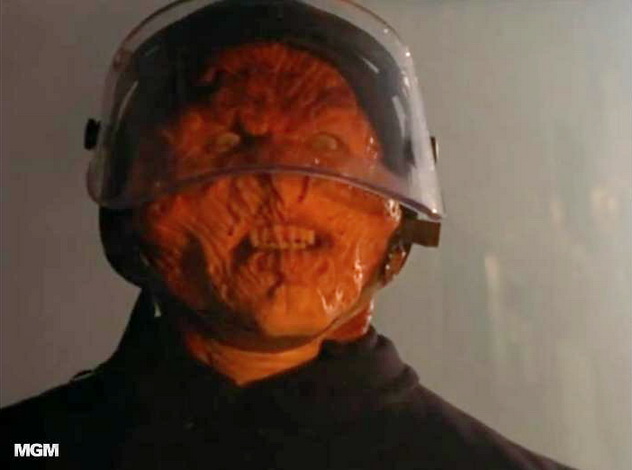
Father Jonascu is on Skid Row handing out blankets to the bums. The police roll in and starting roughing up the crowd. Jonascu is knocked to the ground in the chaos. A cop asks if he is alright, but when he turns to the cop, he sees a demon in a police uniform. Looking a second later, he sees a human cop.
He tells his assistant he thinks he is losing his mind. Understandable, because whoever heard of a priest believing in something supernatural. One of the bums knows that Jonascu saw the demon and begs him to tell others. Father Jonascu will not offer this slight comfort.
Father Jonascu says that he is considering a reassignment, and this is a man who knows what he wants:
Jonascu, when is life is on the line, opts for a scientific reason for his vision. He is diagnosed as having a brain tumor. He takes this as a cause rather than effect. He was fine until he saw the demon, he reasons.
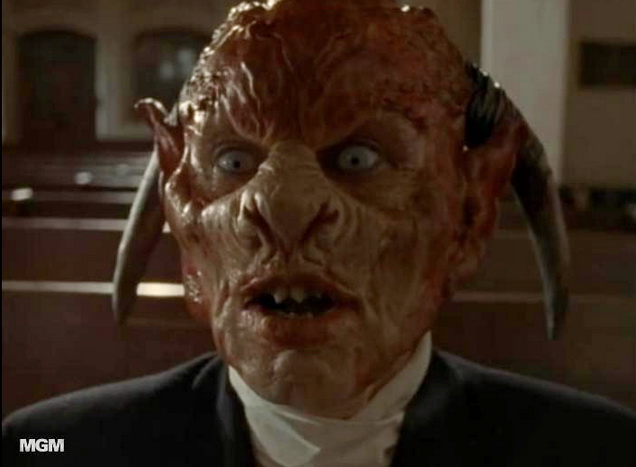
During his next sermon, he sees a woman in the back of the church who is a demon. Seconds later she appears human again, then a demon again. Knowing she has been busted, she runs out. Jonascu gives chase, but collapses.
He begins telling his doctor about the hallucinations, then the doctor plunges a syringe into his neck. The doctor wants to introduce some friends — he opens the door and the demon cop and demon woman are waiting. He turns back to the doctor, who reveals himself to also be a demon, although he says he does not like that label — perhaps the D-word.
The woman says they are “the way,” and that all our religious teachings have descended from them. They have come to deliver the power to heal to humanity. They want Jonascu to be the human face to deliver this gift; understandably.
The lady D-word grabs Jonascu’s head. She cures his tumor, but the transference kills her. Apparently there are no young boys in the hospital, so he lays hands on a young girl injured in an auto accident, and instantly heals her. Once the press is notified, his life becomes very busy as he heals hundreds.
Jonascu’s assistant overhears the D-words discussing their real mission — to siphon off earth’s atmosphere. He is dealt with appropriately. For some reason, it takes Jonascu a long time to figure out he might be able to resurrect his assistant.
Turns out, he was only “mostly dead” and Jonascu brings him back. Ironic since the doctor is played by Prince Humperdinck. The two priests confront the D-words.
At this point, I got completely lost. Jonascu grabs the D-cop’s head, but the “healing” action somehow kills the alien. Does that mean the aliens can’t heal each other? Does that mean the aliens aren’t “normal”? That after removing the bad parts, there was nothing left? Seems a little racist. Then the D-doctor grabs the priest’s head; and the priest grabs the D-doctor’s head at the same time. As they struggle, the assistant priest jumps into the mix and grabs the D-doctor’s head. After a lot of sound and fury, Jonascu and the D-doctor are dead, and the assistant has the healing power. It took slow-motioning this a couple of times for me to get it.
In a long shot of the carnage on the altar of the church, we see the D-woman observing from the back of the church. But wasn’t she killed after transferring her power? Does that mean the D-doctor and Jonascu are going to come back to life? It’s one thing to leave the story open-ended, but you have to establish some rules.
Once it was clear this was going to be another religion / sci-fi hybrid, I feared another White Light Fever caliber fiasco. Luckily it was handled better this time, and turned out to be a good episode.
I’d like to think we are moving out of the European phase of this series since we have an American prominent in the cast. But confidence is not high — next week’s director has an accent grave in his name.
At least the Brit du jour is Denholm Elliott, most famous in this country for fun performances in Trading Places and the prime-numbered Indiana Jones films. Elliott had the good sense to fake his own death — speculating here — in order to avoid Indie & the Crystal Skull.
Dan O’Herlihy is inventor Charles Braling. He has taken all his valuables out of the bank and is storing them in his home over his lawyer’s objections. His brother Elliott has stopped by to borrow a few pounds as he apparently does on a regular basis. Braling tells him he is dying, and is building his own coffin. For some reason it is 9 feet long and has a window and a tape player.
They bicker continuously with Elliott being oddly belligerent for guy who depends on his brother for support. Elliott finally goes too far and brings up Braling’s dead wife. Braling throws him out, but the excitement was too much for him. Elliott hears him collapse.
Elliott makes funeral arrangements for his brother, choosing the cheapest coffin and opting for no service. Well, one service is permitted — the reading of the will. His brother has left him the house, but taxes will eat up most of it. However, he also willed him the contents, including all his valuables, hidden somewhere in the house.
Elliott deduces that the fortune is hidden in the coffin. As he climbs in to retrieve the goodies, the lid snaps shut. Braling’s robot servants serve as pallbearers, in a well-directed scene. You don’t see much, but you do see enough to accept that these robots actually are moving the coffin, negotiating the stairs, heading into the woods, and lowering the box. The sequence is especially credible, paying off a previous scene where we saw Braling pacing off distances and noting directions — now we know it was for the ‘bots to follow to the grave-site.
En route, and as he is being lowered, and covered with dirt, Elliott is of course screaming. He is better portraying panic than outright terror, but it works OK.
Not a bad episode, even though murdering the brother seems a tad excessive. Plus, what of the loot that was buried with him? Surely that could have been put to better use. But then, people are buried with diamonds and gold all the time. Or so the funeral directors would have us believe.
Post-Post:
This is the 6th highest rated RBT episode on IMDb which does not bode well for the future viewing.

 Carl and Annette Borden are at a going-away party for career girl Lorna. She is moving to San Francisco and leaving her enormous dog Cassandra with the Bordens.