Ray Bradbury Theater – The Fruit at the Bottom of the Bowl (S2E1)

bradbury02A Ray Bradbury twin-spin!

A few months ago I picked up the entire series of Ray Bradbury Theater on DVD for under 10 bucks.  The price should have been warning enough, but I did have dim memories of enjoying a few of them way back when.  Last year, I bailed after the first season, but have decided to soldier on to see if I was too hasty.

As luck would have it, the first episode I watched is based on a short story that appears in Bradbury Stories: 100 of His Most Celebrated Tales, which I recently downloaded to my Kindle.   So finally, I can brush off my mad compare & contrast skillz from freshman English.

No, seriously . . .

And I got an A every quarter . . .

Do I have to get my transcripts?

No one is going to watch this episode and recommend the series to their friends.  The synthy 80’s score is off-putting, and the whole thing looks like it was filmed through gauze of the same thread-count they use to film Barbara Walters (although that could just be the lousy DVD transfer of this dirt-cheap set).  However, in the context of an anthology series, and given when it was made, it interested me enough to at least try another episode.

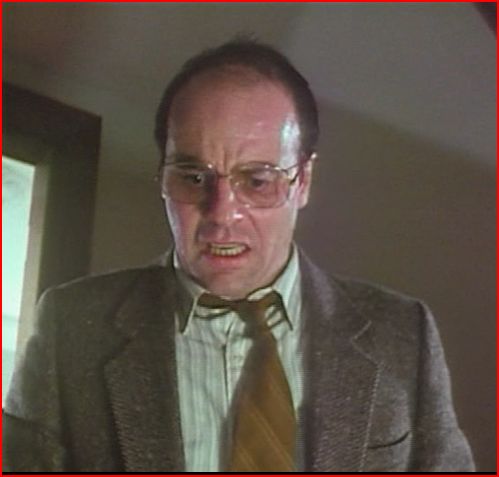
ironside01The first surprise was Michael Ironside.  He has made a nice career out of playing tough guys, always in control.  This is the first time I remember seeing him in panic mode, sweating profusely, and always a step behind.  He completely pulls it off, having an anxiety attack that lasts most of the whole episode. He is assisted by some good make-up, costuming, and fish-eye shots, but major kudos to him for playing so believably against type.

His adversary is Robert Vaughn, who I don’t see much anymore.  I can only assume Superman III killed his career.  Geez, Christopher Reeve, Richard Pryor, Margot Kidder — and people think Poltergeist was cursed.  Jackie Cooper is gone too, but at 88, he had a pretty good run.

Vaughn is a publisher who has rejected Ironside’s work.  He is, however, very accepting of Ironside’s girlfriend Mary.  Through a series of flashbacks that make LOST look like a linear narrative, we follow Ironside as he attempts to remove his fingerprints after killing Vaughn.

As he descends into madness, the fingerprints begin appearing everywhere, taunting him like a visual Tell-Tale Heart. As he frantically cleans his fingerprints, both real and imagined, he realizes that Vaughn had been leading him on, luring him into touching object after object from a cocktail glass to pre-Columbian art.

Finally, after a night of frantic cleaning that would give Felix Unger the willies, that would sent the CSI crew to the nut-hut, that would have him polish more knobs than Jenna Jameson, the police arrive.  They lead him out in handcuffs which, come to think of it, would not have been possible for him at the end of Total Recall.

I’m not sure I follow the ending.  A neighbor, who is also Vaughn’s doctor, who happens to be at the crime scene, who conveniently forgets about doctor-patient confidentiality, spills the garbanzos that Vaughn only had less than a month to live due to cancer.  In fact, he says Ironside probably did Vaughn a favor.

OK, so Vaughn goaded Ironside into killing him and also made sure that plenty of evidence was left to incriminate him.  But to what end?  No mention is made of insurance.  And how does the mere presence of fingerprints incriminate Ironside?  And why set him up anyway?

The short story is a little different.  Very minor point, the girlfriend’s name is Lily, which is a better name than Mary (sorry, Mom).  And there is no mention of any terminal disease.  If the cancer twist had been worked into the show more elegantly, it might have worked.  As is, the short story was probably better off without it.

Post-Post Leftovers:

jenna01a


I saw Jenna Jameson on an episode of Family Guy this morning, so she was fresh in my mind.

Yeah, that’s where I know her from.


Alfred Hitchcock Presents – The Belfry (S1E33)

A number of books and a couple of movies have made the assertion that Alfred Hitchcock had — shall we say — issues in dealing with women.  There is enough smoke to suspect a genuine fire of some sort.

pat01Some of that weirdness seemed to fester in his own family.  Hitchcock had a daughter Pat that appeared in several of his films and TV episodes.  She is not particularly attractive, certainly not anything like the cool blonde type that Hitchcock like to cast.  What is strange, is that he seems to go out of his way to point that out.

Here she is cast as a school marm (in the pre Hot for Teacher days).  Earlier in the season, she had played a maid, and then a woman traveling with her mother.  In his movie Stage Fright, he has her playing a character named Chubby.  Worst of all, he just uses her looks for a joke in Psycho.  After a client has been flirting with the uber-hot Janet Leigh, Pat says, “He was flirting with you.  He must have seen my wedding ring.”  I’ve seen Psycho a couple of times with crowds and it gets a good laugh. Maybe that’s the reason Psycho was her final big-screen appearance for Sir Alfred.

After the one-room schoolhouse lets out, teacher Ellie gets a visit from Clint.  He is too old to be a student and it is soon obvious that he is a little slow.  He invites Ellie to see the house he is building for them.  She reminds him that she is engaged to marry Walt, who just happens to walk around the corner at that very second.

In his brief screen time, Walt seems to be an OK guy.  The actor is none too bright, though, as he seems to think Ellie’s name is Ella.  Really, her father’s name is the title of the show; you couldn’t put a little effort into your 4-line part?  IMDb says the actor was born in Lynchburg, TN.  Home of Jack Daniels.  Just sayin’.

Clint is none too happy at this turn of events.  He and Walt have words; but no big ones. He tries to take the ring from Ellie, and Walt admirably comes to her defense.  Clint gives him a hatchet to the chest right in front of the school.  Clearly he was not aware this was a hatchet-free zone (no thanks to the NHA).

Clint has been carrying this hatchet for the entire episode.  Including in the schoolhouse when he asked Ellie if she was alone — some sort of bell should have gone off.  Luckily, this schoolhouse doubles as the town bell tower, so there was one available.

Clint goes on the lam, hiding out in the woods.  Being no steam-engine scientist, he figures this will blow over in a couple of days.  After eluding the search party which was so close that their lanterns illuminated his face, he returns to the scene of the crime. Literally, right back to the schoolhouse where he climbs into the belfry.

He spends the rest of the episode in the cramped belfry except for a brief trip downstairs into the classroom where he cryptically writes “Lee git you to” on the board.  The next 15 minutes are a series of near-discoveries, the bell CLANGING just inches from Clint’s noggin, and him eavesdropping on conversations below.

kid02I do appreciate that a couple of times when kids are attempting to retrieve a softball, they are shown climbing up onto the roof.  It appears to be the actual child actors.  Like the young smokers in The Incredible Melting Man, it just shows how far we’ve come as a society.  Or the growing power of the Midget Stuntman Union Local #302.

The next day, Clint hears a funeral service for Walt below, as the schoolhouse apparently also serves as a church.  No wonder Clint was so proud of the house he was building, it will apparently be only the second structure in town.

The ending is completely botched.  One of the search party, for no reason, goes to the schoolhouse and rings the bell, startling Clint.  He yelps, giving himself away.  A better ending would have been to give Walt the bell version of a 21-gun salute at his funeral service.  The constant CLANGING would have driven Clint mad.  In a way, it would have been Walt himself bringing him to justice.

Post-Post Leftovers:

  • “Our father which art in heaven . . . ” ?
  • I was sure posse member Elmer was played by Newt Kiley from Green Acres, but no.
  • OK, after reviewing, we see a book signed by Ella Marsh, so maybe Walt wasn’t Jack’d (as in Daniel’d) up after all.
  • C’mon, with that giant hole the the bell rope goes through, no one thought the baseball might have dropped to the ground floor?
  •  Where else has a bell tower figure prominently in a Hitchcock joint?  Vertigo!  Surely this episode and drawing were Easter Eggs, a callback to that film.  Oh, wait — Vertigo would not be released for another 2 years — never mind.  Orrrr,  maybe it gave Hitchcock the inspiration – yeah, I’m going with that.belltower01

Alfred Hitchcock Presents – The Baby Sitter (S1E32)

ahbabysitter00Alfred Hitchcock Presents seems to have been almost completely, but unfairly, overshadowed by The Twilight Zone.  I think I will always prefer TZ, but AHP was an impressive body of work, and deserves more recognition.

First of all, look at the sheer numbers – AHP (followed by The Alfred Hitchcock Hour) ran for 10 years, and produced more than twice as many episodes as TZ.  And this was back in the days when a season could run up to 39 episodes.  Granted, Hitchcock was not scripting almost a third of his series like Rod Serling, but he did appear on screen in every episode and directed 18 of them.  Plus, had a day-job.

Having watched much of the first season pre-blog, I am starting here with Episode 1-32 The Baby Sitter.  Two things struck me almost immediately in this episode. First, I don’t know how to spell baby sitter.  I would have thought it was one word, but Dictionary.com does not even list it as a noun; neither does Merriam Webster;  my Kindle’s dictionary grudgingly calls it a derivative, but clearly is not happy about it.  Next week on Grammar-Talk: Can you have 2 semi-colons in one sentence (and is there such a thing as an Oxford semi-colon?)?  Second, there is no intro by Hitchcock – a rarity as far as I can tell.ahbabysitter03

Lottie Slocum is a widow who works as a baby sitter, despite being overqualified to the tune of 40 years (suffice it to say, no websites are being devoted to her).  She is played by Thelma Ritter who, 2 years before, had been the comic relief in Hitchcock’s Rear Window (not Raymond Burr, as you might have expected).

The story opens with her being questioned by a detective as she is one of the last people to have seen Clara Nash alive.  The detective is clearly frustrated that Lottie seems to be carefully doling out info, relishing the attention gained from from her role in this tragedy.  Said role being that she babysat for the victim’s son – she is not a witness, not a suspect, didn’t narrowly escape the murderer, wasn’t caught wearing the victim’s jewelry, etc.  Yeah, she saw the victim, but she wasn’t Abraham Zapruder.

Lottie’s even less attractive friend Blanche (Mary Wickes) shows up apparently for the sole purpose of cruelly mocking Lottie’s crush on the late Clara’s husband, soon suspecting that Lottie killed Clara out of jealousy.

Lottie gets a visit from DeMario, the man Clara was cheating on her husband with.  A tough guy with dark features, I assume he was intended to be one of them menacing eye-talians.  IMDb says the actor Michael Ansara was born in Syria.  But I’m not sure anyone in 1956 knew what an Assyrian was as Catch-22 wouldn’t be published for another 5 years.  BTW, he went on to play Kang in Star Trek and married Barbara Eden, so he was a hero to American males of all ages even if we didn’t know his name.

DeMario serves a dual purpose.  He credibly proclaims his innocence, and Lottie does not seem to suspect him.  So, when he warns Lottie not to further embellish her stories, it forcefully emphasizes the fact that she is a nut whose attention-whoring could do some real damage to an innocent man.  Secondly, his fling with Clara gives at least 2 people a motive for Clara’s murder.  OK, innocent of murder, but not a good egg.

Lottie writes a love letter to Mr. Nash – ya know, the guy whose wife was just murdered – prompting a flashback.

ahbabysitter01

Actual Closed-Caption

And this unfortunate bit of closed-captioning.

I’ll leave the context to your imagination.

Jeez, it only took one blog post to descend to this level.

Still in the flashback, Lottie is at the Nash home with Mr. Nash when DeMario brings Clara back home after a date.  Hunh?  Bizarrely, Mr. Nash calmly goes to hide in the bedroom, and Lottie seems to think this is a reasonable reaction for a husband.  It doesn’t seem to be fear of DeMario – Lottie writes, “It was nice of you not to want to be present when she came in with that boyfriend of hers.”  Hunh?  Mr. Nash does not seem to have a full name in the episode.  Might I suggest Tobias Fünke Nash.

Back in the present, Mr. Nash shows up.  Lottie reveals that she had promised to protect him, by omitting certain facts, such as whether he was there the night of the murder.  He burns the letter, then kills Lottie.  Not a moment too soon, although I would have burned the letter second.

Not positive about this, but despite a fair amount of screen time, I’m not sure Mr. Nash spoke a single word.

Comeuppance: In Hitchcock’s epilogue, he assures the audience that Mr. Nash got his due as he was killed by a train.

Sadly, not a great episode to start with if my thesis is that the show is under-appreciated.