Tales from the Crypt – Dead Right (S2E1)

tftcdeadright01Dinty Moore goes to see a psychic on her lunch hour.  Madam Vorma has the second sight and reads vibrations.

Vorma reads her as a secretary wasting her life away, waiting to meet Mr. Right or Mr. Rich.  She says Dinty will lose her job and get another one today.  Dinty says her boss is out of town so this is impossible.  But Madam Vorma knows her stuff.

Dinty is fired (by Sarah Connor’s shrink) for for taking 25 minutes too long at lunch.  Walking down the sidewalk, a strip club manager offers her a job.  Sadly, as a waitress.

tftcdeadright03aDinty goes back to Vorma.  She “sees” Dinty getting married, and her husband inheriting a lot of money shortly after they are married.  After he inherits the money, he will die violently.

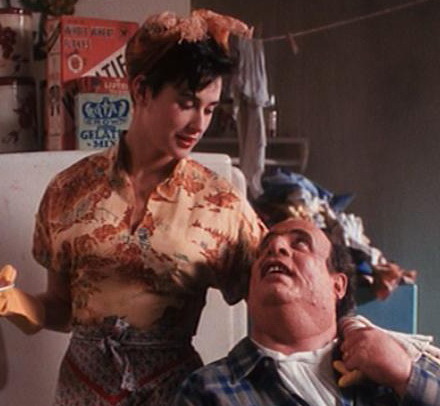
Back at the club, Miss Nude Nebraska 1948 is introduced.  Thank God this was not set in present day.  Dinty sees George (or possibly Oscar) Bluth waddle into the club.  He begins hitting on her.  Jeffrey Tambor, not a looker on his best day, is padded out in a repulsive fat suit, blubber and prosthetic nose.

Dinty is disgusted by him but her greed out-weighs her nausea.  Soon they are dating and married.  Unexpectedly, Dinty wins $1 million by being the one-millionth customer at the tftcdeadright04automat.  Taking place 50 years ago, this must have been the combined revenue of every automat in the country.  That’s probably what killed them.

Vorma is proven correct in her predictions and, as always, justice is served like apple pie at an automat.  Sadly, though only to Dinty —  Tambor is really an object for pity in all of this.  A hideous hulk who actually thought he was going to be happy with a beautiful wife — what a maroon.  And though he did kill her, it was her greed and cruelty that propelled him to old sparky.

The episode ends ominously with another customer coming to Vorma.  Yet another botched ending as it suddenly shifts perspective to make Vorma the focal point of the evil.  All she did was correctly predict the future.tftcdeadright05

Still, a good twist and some excellent performances from the leads make this a great episode .  Also some great make-up on Tambor, and some great style — fashion, make-up, hair — from Dinty.  She really comes off as a classic movie star.

Post-Post:

  • This aired just as Demi Moore was becoming huge — Ghost was the same year.  A Few Good Men, Indecent Proposal and Disclosure would open in the next four years.
  • She really was nothing short of perfect in this.  It’s too bad she didn’t use that comedic talent in more of her roles.
  • Howard Deutch also directed the episode Only Sin Deep.

King of the Zombies (1941)

kingzombies0220 movies for $5.  What could possibly go wrong?  part VIII.

I went into this expecting something like White Zombie with Bela Lugosi.  In tone and quality, it was no White Zombie.  King of the Zombies is a comedy intended to capitalize on (i.e. ripoff) the success of Bob Hope’s Ghost Breakers released the previous year.  I can’t say how successful it was at the box office, but as a comedy, it is not a complete failure, except by all modern cultural standards.

Mac McCarthy is piloting a plane carrying Bill Summers and Jeff Jackson.  They have lost their way “somewhere between Cuba and Puerto Rico”, which is apparently what they called Haiti in 1941.  Running low on fuel, Mac says he must put the plane down in the jungle.  Jeff observes, “I knew I wasn’t cut out to be no blackbird.” Thus, Jeff is established as the comedy center in a Stepin Fetchit sort of caricature; he is even sitting in the back of the plane.

kingzombiemoreland0The model plane lands in the model jungle knocking over a few model trees on the way.  Despite all 3 men being thrown from the fuselage in the crash, they are unhurt.  Jeff, however, wakes up believing himself to be dead.  When Bill assures him they are alive, Jeff says, “I thought I was a little off-color to be a ghost.”

Anyway.

They find a house in the jungle and let themselves in.  The owner Miklos Sangre greets them and offers them drinks.  You can’t accuse the movie of not being multi-culti when the villain is an Austrian refugee with a Greek first name, Spanish last name, and German accent. Mac tells the owner that they picked up a strange radio broadcast as they were landing.  The owner says he must be mistaken, there is no broadcast.  The next boat is not due for 2 weeks,  but he offers them rooms.

Naturally, Jeff can’t stay upstairs with decent (i.e.white) folk, so he is escorted downstairs. Getting a glimpse of the titular Zombies, Jeff bolts back upstairs and begs his companions to leave.

Sangre introduces them to his wife who seems to be a Zombie, or at least a real cold fish.  And his niece who is not. Mac inquires about another plane which crashed in the area recently.  Sangre pleads ignorance, but will “ask the natives” in the morning.

Sangre is clearly modeled after Bela Lugosi’s character in White Zombie.  Lugosi was actually offered the role, but was unavailable.  The script still reflects his participation when Sangre says, “Zombies never eat . . . meat” mimicking Lugosi’s line in Dracula, “I never drink . . . wine.”  Although that doesn’t make sense when you think about it.

kingzombiemoreland01This is all Mantan Moreland’s movie.  Apart from a few quips from Sangre’s “help”, no one else has any laugh-lines.  It is easy to cry raaaaacism, but really, was Bob Hope a symbol of manhood playing so many cowards back then?  Didn’t Lou Costello play a a man-child idiot for decades?  Moreland became one of the first black millionaires, and was a pretty funny guy, often improvising lines.  Sadly, it appears that Hollywood was offended by his shtick and banished him in 1949; he did not make another movie for 15 years.

Someone would have to be having a pretty bad day for me to recommend them spending 67 minutes of it on this. In fact, I can’t imagine such a scenario.  On the plus side, I did finish it and had a couple of guilty laughs.

Unratable.

Post-Post:

  • Incredibly, Edward J. Kay’s musical score was nominated for an Academy Award in 1942.  He didn’t win, but then his competition included Max Steiner, Alfred Newman, and Bernard Herrmann for Citizen Kane.  Impossible to imagine Hollywood snobs today even admitting to watching a movie like this.
  • Mantan Moreland was considered as a replacement in the Three Stooges after Shemp died.  Anyone who saw the post-Shemp shorts knows that he could only have improved them.
  • Holy crap, I had no idea Stepin Fetchit lived until 1985.
  • Or that his son killed 3 and injured 15 as the Pike Killer shooter on the Pennsylvania Turnpike in 1969.
  • Available on YouTube, but why would ya?

Outer Limits – Virtual Future (S1E7)

olvirtual01Josh Brolin is working on a virtual reality program and discovers that he can project himself into the future.  All the great low-budget sci-fi tropes are here:  Incredible cutting edge science being developed by only 2 guys in a dark lab, world-changing discovery worth billions being treated as only moderately interesting, security for this goldmine laxer than Doc Brown’s garage, and a wife who doesn’t appreciate the magnitude of the work.

And for the most radical discovery in history — time travel — Brolin sells out pretty cheaply — for a job and his own lab.  Who knows, maybe he can even get a 3rd guy and a light bulb.  As in previous OL episodes, there must be a sinister corporate weasel to exploit Brolin’s discovery for eeeeeveeel, here played by David Warner.

It surely break’s Warner’s heart that the first time he takes the leap forward, he uses that knowledge to save a woman from being murdered at an ATM.  Well, there’ll be time for blackmail and murder later.

Soon enough, Warner announces that he is running for the Senate, thus commencing his life of crime.  Sadly, he does a time-jump, and sees that he will lose the election, and his victorious opponent will subpoena the records of his company.  The next morning, Brolin sees on TV that Warner’s opponent has died mysteriously.

There is a confrontation, and soon all is well again with the world.  Well, except for the dead guy.  Another just OK episode.  Brolin, however, shows the chops that will make him a star a few years later.  David Warner, as always, plays the role of David Warner, but totally pulls it off.  Sadly, the wife is a little bit of a non-entity, but does come through like a champ at the end.

Post-Post:

  • Sadly Brolin did not use his knowledge gained from time-travel to warn everyone, “Don’t remake Oldboy.”

olvirtual02

Grand Piano (2013)

grandpiano00Holy crap will I be recommending this to people tomorrow!  And real people, not the imaginary ones that visit this blog.  You can nitpick this to death, and many already have, or you can just accept it as some great, fun entertainment.

Elijah Wood is Tom Selznick, a concert pianist whose career has been derailed by stage-fright since making a mistake in a complex piece five years ago.  Apparently these classical music dweebs hold grudges like a Muslim.

Finally his wife has has persuaded him to make a comeback.  As he is playing from the sheet music, he begins to see arrows and notes.  He has also been provided with an earpiece that enables him to speak to his tormenter.  A man with a laser-sighted rifle will kill his wife if he does not play every note in the same complex piece correctly tonight.

grandpiano01At this point, it is much like Phone Booth, but better.  Or Season 1 of 24, but worse. Great as Grand Piano is, nobody puts Jack Bauer in a corner.

Much has been written about Grand Piano as being being in the vein of Hitchcock and DePalma (although I’m not sure what represents DePalma except maybe a split screen shot).  It is hard to mistake the Hitchcockian elements — a man in over his head, a timeless theater set, paranoia, inventive camera angles, classical score.  I think either one of them would have been proud of how this shot plays out:

grandpiano02

Must see to appreciate.

The great cast features Allen Leech, Tom Branson from Downton Abbey (who was a little bit of a distraction as he really resembles Samwise Gamgee sitting in the audience).  Don McManus is as over-the-top as you would imagine a great conductor to be (or Don McManus to be, for that matter).  It is nice to see Alex Winter (who was either Bill or Ted and made the underrated Freaked) as a conspirator.  And, of course, Elijah Wood was great, continuing his recent streak.  His, er, not-classic looks are perfect for an emotionally scarred concert pianist.  John Cusack, heard but not seen for most of the movie, gives his usual competent performance.  The only weak point was his wife Emma, played by Kerry Bishe; but maybe only because her on-screen sister was so much hotter than her.

There is a lot of chatter online about the ridiculousness of the plot, and of the ending.  Most, however, do not deny that there is a great style to the movie and that it is successful in generating suspenseful.  So why would you quibble on minor points?

I rate it 84 out of 88 keys.

Post-Post:

  • Thanks to the filmmakers for giving us 12 minutes of end credits rather than padding out the story.  But really, would an 85 minute run time have been that terrible?
  • I’m shocked, shocked! that on Rotten Tomatoes, this has an 82 from critics, but only a 50 from normal humans.  I would have strong expected the exact opposite.
  • I patted myself on the back for getting an obscure Edie Sedgwick reference when Bishe was standing in front of a poster blocking out all but E_____ick.  In retrospect, I was full of crap.

grandpiano03

Ray BradburyTheater – Punishment Without Crime (S2E7)

cover02Another bloody European episode.  At least we have a recognizable face in this one — Dr. Loomis himself, Donald Pleasence.  Despite airing 22 years after Fantastic Voyage, he has barely aged at all.  Which is a sad commentary on his 1966 self.

Pleasence is George Hill, a billionaire investment banker who is married to a woman 40 years his junior — I have no problem with that.  It is, admittedly, kind of creepy to see them together.

In an ineptly choreographed scene which involves the complex procedure of, er, opening a door, Hill sees his wife Katherine making out with a man who is also approximately 40 years his junior.

Update: I finally realized what happened.  Although the story is told 99.9% from Hill’s first-person POV, the director inexplicably switched to a third-person omniscient-POV for about 2 seconds.

So, naturally, Hill hatches a plan to a) have a robot duplicate of Katherine built (and she was built to start with, heyyyoooohhhh), and 2) kill said robot.  Having the cash, a better plan would have been to build 2 robot Katherines and not kill them.  But then, he’s a pretty old dude and this is PV (pre-Viagra).

rbpunish01The plan really makes no sense unless you look at it as a cathartic act where just going through the motions will give him some satisfaction — like Westworld.  But Katherine will still be alive.  And, by the way, will expect half his stuff to be handed over to her and her lover in the divorce.

Such is his anger that he can’t stand to wait the 2 weeks it takes Facsimiles, Inc to build the perfect mechanical duplicate of Katherine.  BTW, like all high-tech facilities in low-budget sci-fi, it has the standard completely inefficient floorplan, and is apparently staffed by one person who sits in the dark until needed.  Hill opts to be put into suspended animation until she is ready.

Naturally, once he meets Katherine 2.0 (now with fidelity!) he decides he wants to keep her.  Alas, that is not an option as she can’t be bought, only rented.  If she is an Apple product, there won’t even be a way to replace her battery.  Hill insists there must be a way he can keep her, but she has been well-programmed.  She speaks of cheating just as Katherine 1.0 did to taunt him into shooting her.  It works as he shots her and synthetic blood spills out onto the white floor.

Within seconds, a police detective arrives and arrests Hill for murder.  He is put on trial because a few hand-wringing do-gooders have decided that robots should have the same rights as humans.  He is found unanimously guilty in a televised trial that seems to be some sort of precursor to reality-TV, complete with soundtrack and stinger queues.

rbpunish03Katherine 1.0 comes to visit him in jail.  Even though the jailers know Katherine is alive, the sentence is carried out.

Post-Post:

  • Unlike my recap — a model of economic narrative — the episode opens with a framing scene, then a flashback, then a flashback within the flashback, ending with the same framing scene.  Sort of.
  • The opening and closing scenes cover the same material, just as in Pulp Fiction.  Also, just as in that film, the scenes are not exact duplicates.  I give Tarantino the benefit of the doubt that there was a point to his changes due to shifting perspectives, or even the nature of reality.  I think it was just incompetence here.
  • Nice cell he has, with access to the prison exterior security cameras.