Ann B. Davis Dead at 88
Reply

 Full title: “Dig that Cat . . . He’s Real Gone”. But I wasn’t sure it was worth that much headline real estate.
This gets off to a very rough start. Oddly, the calliope score here did not work for me as well as it did in The Man Who was Death despite this episode being set in a carnival. I guess that’s why you pay extra for Ry Cooder.
Things do not improve with the 1) the use of a distorted lens, 2) having the camera be directly addressed as a carnival goer and 3) the appearance of Robert Wuhl.
Even Wuhl’s patter is awful. He somehow entices the rubes into his show saying that it is “100% natural, no pesticides, but perhaps a homicide.” The homicide part makes sense, as we will discover; but for the couplet to work, there has to be some point to saying pesticide other than just that it rhymes. I expect more from a carny. It’s like vaudeville for people with missing fingers — they use the same routine for years, generations; passed down from father to son, brother to brother; sometimes in the same transaction. They would have had it polished to perfection around 1920.
 He promises “two shows in one — the tragedy of death and the miracle of resurrection!” He introduces Ulric who will be buried 6 feet under, and return to life 12 hours later. Things immediately take a turn for the better as Ulric is played by Joe Pantoliano. Once settled in his grave, Ulric addresses the audience, flashing back on how he acquired this talent.
Ulric was a bum, er, Homeless-American when Dr. Manfred offered him cash to participate in an experiment. Manfred came up with a way to transfer a cat’s 9 lives to a human. Rather than sell this discovery to Big Pharma, or to some aging billionaires, Manfred decides the big money is to be made in smelly tents from rubes eating corn-dogs and funnel cakes.
Ulric is skeptical that the operation actually accomplished anything other than killing the cat until the doctor pulls out a gun and shoots him in the head. When he reawakens, he is angry until he realizes that the doctor was telling the truth.
 So they split the take as Ulric is killed on a nightly basis by drowning, electrocution, hanging, arrow to the heart, etc. I can understand Ulric not fearing death, but it’s hard to believe he would subject himself to such painful events; unlike Cypher, he is coming back. These things have got to leave a mark. And is that bullet still in his head?
As usual, there is a great twist and justice is served. Suffice it to say, Ulric finishes his story in the same coffin where he began it; just in a much louder voice.
This series and its source material revel in going over the top. Robert Wuhl and much of the direction had the energy, but in this case were just too annoying.
I rate it 4.5 out of 9 cat’s lives.
Post-Post Leftovers:
 20 horror movies for $5; what could possibly go wrong? Part IV.
This is not part of the Universal Classic Monsters box set. I am going to give it the benefit of the doubt and say that is only because it is not a Universal picture.
Betrothed couple Madeline & Neil are being taken by horse-drawn carriage to the plantation of Charles Beaumont, when they encounter a funeral taking place in the road. The driver explains that burials are made there to protect the dead — body-snatchers do not want any witnesses; also probably not too interested in being trampled to death by horses-drawn carriages, so a win-win.
 The driver later needs directions and for reasons unknown, Bela Lugosi happens to be standing by the side of the road. The driver, to the shame of men everywhere, pulls over and asks for directions. Lugosi ignores the driver and approaches the passenger compartment. Silently, he stares at the couple, placing his hand on the door, and on Madeline’s scarf. The driver sees Lugosi’s zombie entourage shambling up and gets the carriage moving again. Lugosi is left with a handful of Madeline’s scarf, which luckily was not too tightly knotted around her neck.
Only 4 minutes in, but I was surprised that I was finding this movie to be pretty effective for an unremastered public domain joint. The drums and the native chanting create a chilling atmosphere. The drive-by funeral and scene with Lugosi already provided some iconic visuals.
At their Haitian plantation destination, Neil asks the driver why he was so reckless in driving away. He explains that “they were not men, they were dead bodies, zombies, the living dead, corpses taken from their graves, made to work in the sugar mills and fields at night”.
Neil & Madeline meet local missionary Bruner at the Beaumont estate. Madeline says she just met Beaumont on the boat from New York, coming to marry Neil in Port-au-Prince. The missionary says that Beaumont doesn’t usually take an interest in people like this. Beaumont has also offered to make Neil his agent in New York despite his obvious inability to put 2 and 2 together.
Beaumont looks a little like Liberace, but even that does not make him the creepiest resident of the estate. His butler Silver is not one of the living dead, but the cadaverous servant could be one of the dead living. Some clunky dialogue mixed with some missing footage make this an awkward, choppy scene. Somehow, even its imperfections worked for me. It is 80 years old, after all.
After greeting Neil, Madeline and Bruner, Beaumont boards a coach driven by a zombie. Again, the atmosphere is well set with the deafening croaking of tree frogs, and the blank-faced zombie driver.
 Beaumont arrives at the mill of Murder Legendre (Lugosi). In yet another iconic scene, we see Zombies Local 102 mindlessly carrying in baskets of sugar cane and dumping them into a thresher. Other zombies are slowly turning a big wheel, grinding the cane. When one of the zombies falls into the thresher, there is no move to save him, or stop the grinding. None of them misses a step. For the love of God, where is the shop steward?
Beaumont has the hots for Madeline, and has come to Legendre for help. Legendre is the proverbial hammer-wielder who sees every problem as a nail, ergo his solution is to make her a zombie. Really, what did Beaumont expect? You’re taking love advice from a guy named Murder, dude.
To his credit, Beaumont thinks that might be a tad extreme. Not so much out of concern for Madeline, but because he would have to live with this dead-eyed thing. Even while escorting Madeline to the altar, he is still hitting on her. Thank God his brother George wasn’t there to see it.
Ever the romantic, Legendre still wants to get these crazy kids together. He wraps her purloined scarf around a candle, and lights it from a lamp to induce a trance. At the reception, looking into a cup of tea, she sees Legendre’s piercing eyes and collapses. There is a hokie but great shot as Legendre walks to the camera.
Madeline is buried in a huge, easy-access, handi-capable crypt, where Beaumont, Legendre and the zombie crew retrieve her while still fresh.
After a night of drinking, making a stumbling fool of himself, Neil goes to visit Madeline’s grave. Discovering it is deficient in bodies to the tune of one, he consults Bruner. The missionary tells him that either the body was stolen to use her bones in a ceremony, or she is not dead.
Legendre has reanimated Madeline, but Beaumont can see there is no light in her eyes, she has no soul. Strangely, however, she is able to play the piano, which should have appealed to this Liberace doppelganger. He asks Legendre to restore her, but there is no way; well, not one that Legendre cares to reveal. But Legendre does the next best thing and zombifies Beaumont, clearly thinking that the 1930’s were not ready for a mixed marriage.
In what plays out almost as a silent movie, Legendre compels Madeline to stab Neil, but she resists and runs away. Neil is able to follow her out of the castle to an escarpment. Legendre makes with the trance again and his zombie posse comes to his aid.
When Bruner knocks Legendre unconscious, the zombies become confused and began shambling off the side of the escarpment like lemmings. Madeline comes to life for a moment, even able to smile.
As Legendre regains consciousness, she slips back under his control. Beaumont, who had also experienced a brief moment of lucidity, comes down the stairs and tosses Legendre off the escarpment.
 Once Legendre is dead, his control over Madeline is broken and she awakens. Great for her and Neil, but not so much for the poor saps who threw themselves off a cliff 30 seconds before their potential salvation. And not to quibble, but she was dead-dead, not only mostly-dead. I buy Legendre reanimating the dead as zombies, but this was a full-on resurrection.
On the Universal Classic Monsters scale, I give it a Wolf Man. Shockingly, I have liked 4 of 4 from the $5 box set.
Post-Post Leftovers:
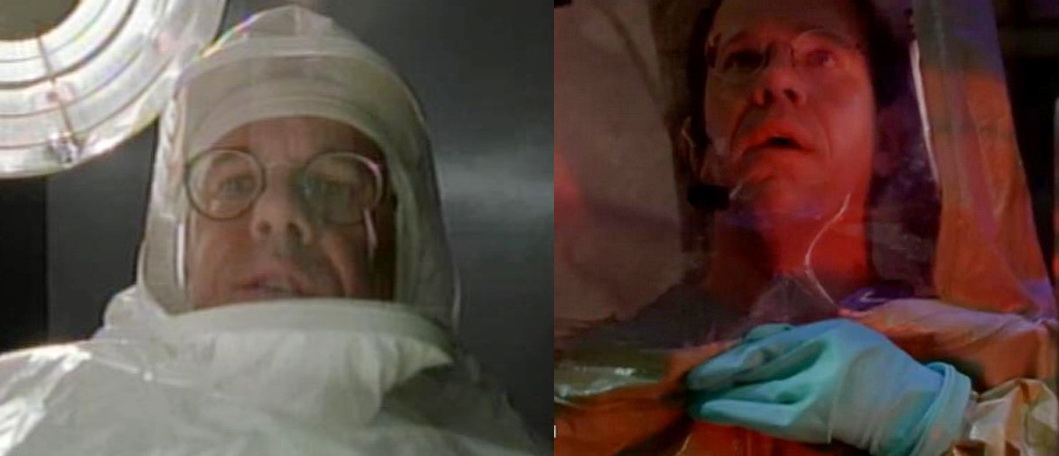 There is a real X-Files vibe in the opening seconds of this episode. The music and lab setting could easily have been from that series. The sense of déjà vu was heightened when I saw Charles Martin Smith who had played a similar role (in profession and haz-mat bunny suit) in the F. Emasculata episode of The X-Files.
In the Outer Limits episode, he plays Dr. Spencer Deighton, a researcher who comes up with a cure-all wonder drug that could eradicate all disease. His brother Michael the CEO-wannabe and villain of the piece, actually has a legitimate point: what if this drug mutated into the rodent or insect population? Even in the human population, with all those extra mouths to feed, it could result in the deaths of millions by starvation. Now, that would have been a great story, but maybe too big for a TV episode.
Unfortunately, Michael undermines his cogent points by stating that the drug could “cut the world death rate by 1000%“. And this guy wants to be my CEO? Not even my latex salesman.
 The acting-CEO agrees and Spencer’s research is shut down. Lab assistant Carl disagrees and injects himself with the drug. Unfortunately he is observed by Michael who runs a decontamination procedure which incinerates him. Again, good call. Are they sure this is the bad guy?
Finally we get to Michael’s dark side. He is not against production of the wonder drug. He just wants to restrict access to the super rich; and certain CEO-wannabees, given the way his hand is shaking.
It turns out that he has concealed the fact that he has inherited the Huntington’s disease that killed his mother. He feels that the negative-nellies on the board might consider his imminent death a disqualifier for the CEO position. Whereas his poor math skills and general douchebaggery will not be an issue.
He discovers that Carl leaked news of the drug to Spencer’s reporter girlfriend Tricia played by Ellen Tighe. Michael pays her a visit and inexplicably douses her with the wonder drug. He then takes a dose himself. And sure enough, it makes his hand as steady as the Waco Kid’s (no, the other hand).

My God! What is that thing on your face!
Back at the lab, the monkey that was was being used to test the wonder drug is in pretty bad shape. Michael reveals to Spencer that he has taken the drug. It also apparently fixed his eyesight as he is not wearing glasses. Spencer will not join Michael, so it is time for another decontamination.
Spencer escapes and Michael quickly begins withering, begging to be killed. Turns out the wonder drug burns out the host’s normal resistance and leaves them defenseless. So in trying to cure his Huntington’s, Michael actually hastened its effects. Oh the irony.
A fairly somber affair. Well-performed, but not a lot else to recommend it. I give it 5 out of 10 cc’s.
Post-Post Leftovers:

NOTE: this is a palate cleanser after a month of daily genre postings.
I am not an Apple user. I own no Apple products. In fact, I think they are a little bit of a cult. But I know a good story when I see one.
I picked up this book because Steve Jobs was such an interesting figure. But what surprised me most about this book had nothing to do with Jobs — there won’t be too many revelations for anyone who has followed the computer industry at all. I was impressed by how well the book was put together by Walter Isaacson.
I am immediately bored by biographies that start out at the big bang, and waste 100 pages getting to the subject. Isaacson takes care of the preliminaries and gets to “Steve Jobs” the character in pretty short order. Of course it helps that Jobs became pretty interesting at a young age.
The milestones, products and key people in his life are presented clearly and concisely — this book moves. Isaacson has done a great job of sticking to the important topics and skimming quickly over most distractions. The only time I got a little restless was toward the end. I think that is probably true of any contemporary non-fiction book. As events approach the current day, things just seem to get frayed and less important (other than his fate, of course).
I just deleted a few small complaints because 1) who am I to judge, and 2) this is a great book, and not just because of the subject.
Etc.
